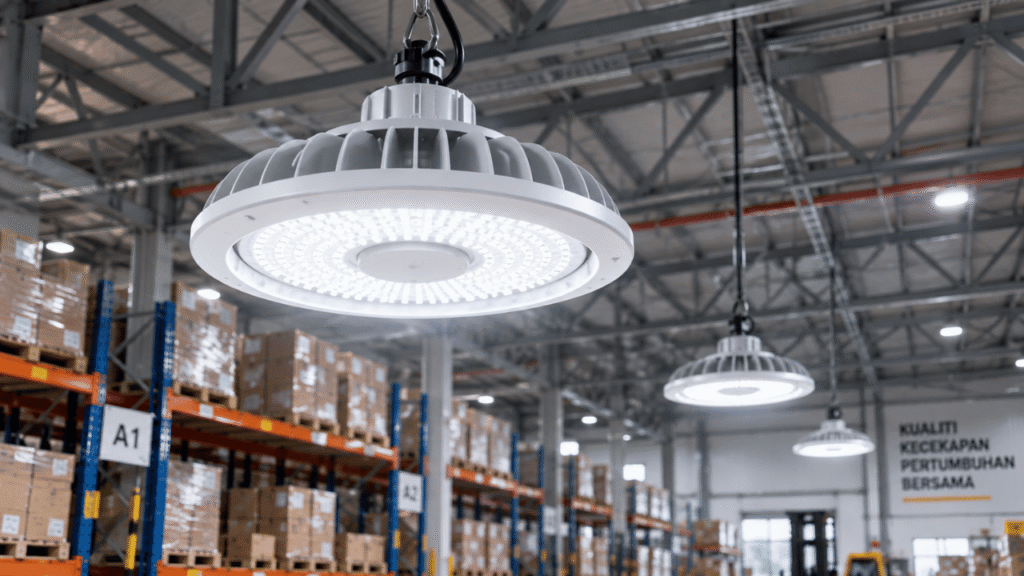
Most factory and warehouse lighting is quietly costing its owner money. Old metal-halide or fluorescent high bays burn far more power than they need to, dim as they age, and get replaced one failure at a time. And when people do switch to LED, the most common mistake is guessing the wattage — buying 100W fittings for a 10-metre roof and ending up with a dim, patchy floor. This page covers what actually matters: the fitting types, how to size the wattage to your ceiling height, and why buying an LED high bay light from a local manufacturer beats an imported box or a marketplace listing.
We manufacture LED lighting in Johor, so the technical parts here come from building these fittings, not reselling them.
LED high bay lights, made in Malaysia
Search “high bay light” in Malaysia and you get a wall of marketplace listings and imported brands, with almost no one explaining what to buy for your space. When one of those fittings fails on a production line, support sits with a distributor two or three steps from whoever made it, and a replacement can mean a dark bay for weeks. We’re the factory. We can match wattage, beam and finish to your building, build to spec for a large plant, and stand behind the fitting after it’s installed. Our LED high bay fittings are SIRIM-certified — the Malaysian standard mark that lighting for commercial, industrial and government projects is expected to carry — and we’re an ISO-certified manufacturer selling direct, which keeps the reseller margin out of your price when you’re relighting a whole roof.
Our high bay range
Three fitting types cover almost every industrial space. Which you need comes down to ceiling height and the shape of the area.
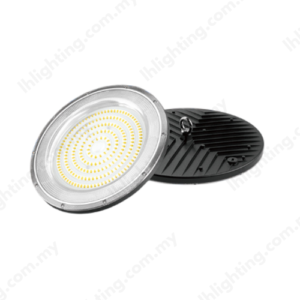
UFO LED high bay
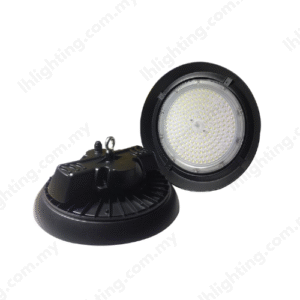
The round “UFO” fitting is the workhorse for factories and warehouses with open ceilings. It’s compact, quick to install on a hook or bracket, and throws an even circular pool of light. For most plants, this is the default.
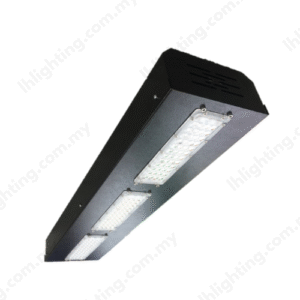
Linear high bay
Linear fittings are long rather than round, so they suit aisles, racking and production lines where you want light spread along a row rather than in a circle. Same LED and driver technology as the UFO — the difference is the beam shape.
LED low bay
For lower ceilings, roughly 4 to 6 metres — workshops, covered loading areas, mezzanines — a low bay fitting gives a wider, softer spread designed for shorter mounting heights.
High bay specifications
These are the specs that decide performance and lifespan. Confirm each against the datasheet before you buy — the ranges below reflect our typical high bay range:
| Spec | Typical range | Why it matters |
|---|---|---|
| Wattage | 100W / 150W / 200W | Sized to ceiling height (see below) |
| Light output | ~10,000 / 15,000 / 20,000 lm | Brightness on the floor |
| Efficacy | ~100–150 lm/W | Higher = lower running cost |
| Colour temperature | 4000K / 6500K | 6500K daylight is standard for industrial |
| IP rating | IP65 | Sealed against dust and water jets |
| Compliance | SIRIM certified | The Malaysian standard mark for lighting |
| Beam angle | 90° / 120° | Narrow for high roofs, wide for low |
| Body | Aluminium heat sink | Keeps the LED cool for a long life |
| Mounting | Hook, bracket or pendant | Matches your roof structure |
How to choose a high bay light
Get these four right and the lighting will do its job for years.
Wattage and mounting height
This is the decision people most often get wrong. The higher the roof, the more wattage you need to land enough light on the floor. As a working guide:
- 4–6 m (workshops, low bay): around 100W
- 6–9 m (standard warehouse): around 150W
- 9–12 m (high warehouse, factory): around 200W
- 12 m and above: 200W or higher, spaced more closely
That’s a starting point, not a rule — the floor task matters too. A packing area or inspection line wants more light than a storage aisle. A quick lighting layout (we can do this from your floor plan) confirms how many fittings and what spacing you actually need.
Beam angle and spacing
Beam angle works with mounting height. A high roof wants a narrower beam (around 90°) to push light down to the floor; a lower or wider space wants a wider beam (around 120°) so the light overlaps evenly between fittings. Get this wrong and you either waste light on the walls or leave dark gaps between fittings.
IP rating for dust and humidity
Malaysian factories are hot, humid and often dusty, and that finds any weakness in a fitting’s seal. IP65 is the sensible standard — sealed against dust and water jets. Wash-down areas, food plants or coastal sites are worth stepping up to IP66. A cheap, poorly sealed fitting will fail early in a dusty plant, which is where the “bargain” unit gets expensive.
Colour temperature and brightness
For industrial spaces, 6500K daylight is the norm — it’s crisp and keeps workers alert. Some offices and showrooms attached to a plant prefer a softer 4000K. Brightness is set by lumens, not just watts, so compare lm/W: a good LED high bay delivers roughly 100 to 150 lumens per watt, which is where the energy saving over the old metal-halide comes from.
Applications
The same core fittings, specced to the space, light factories, warehouses and distribution centres, workshops and production lines, gyms and sports halls, and covered car parks. Because we manufacture rather than resell, we can match a whole site to one spec and finish, hold spares, and quote project quantities factory-direct instead of building the design around whatever a marketplace has in stock. You can see installed work in our project gallery.
Why buy from a local manufacturer, not an importer or marketplace
A marketplace high bay is cheap until it fails on a live line — then there’s no one accountable and no matching replacement, and a mismatched fitting in a row of others is obvious from the floor. Buying from a Malaysian manufacturer means the wattage, beam and finish are matched to your building, spares are held here, the warranty is with the people who made the fitting, and you get a real person to size the job rather than a product grid. It also means the fittings are SIRIM-certified for Malaysian projects — increasingly a requirement on commercial, industrial and government specifications, and something a grey-import or unbranded marketplace unit often can’t prove. For one workshop that’s a convenience; for a factory roof it’s the difference between a lighting system and a pile of parts. This page anchors our wider industrial range, including LED T8 tube lights for factories.
Dalam Bahasa Malaysia
Baca panduan penuh lampu high bay untuk kilang dan gudang dalam Bahasa Malaysia: Lampu High Bay LED Malaysia.
Request a quote
Send us your floor plan or just the building size, ceiling height and what happens in the space, and we’ll come back with the right fittings, a layout, and a price. Project quantities are quoted factory-direct, so the per-unit cost drops with volume. As a rough idea, retail UFO high bays run from about RM100 for budget 100W units to RM600–900 for branded 200W fittings — a project quote will be tighter than any shelf price. Contact our team to get started.